 THE GILBERT FAMILY HISTORY
THE GILBERT FAMILY HISTORY
Harecombe Estate, Crowborough, Sussex
Website created by Richard Gilbert, last updated 13 July 2022.
MAIN NAVIGATION MAP
GILBERT; Waldron 1700s & earlier
|
HASSELL; Waldron --
GILBERT; Waldron 1800s --
GILBERT; to the USA
|
SODDY; Sussex & London --
GILBERT; Eastbourne 1800s --
MORRIS; Lewes & Eastbourne
|
HEWITT & HEDGEGOTT --
GILBERT; Eastbourne 1900 onwards --
CLEMENTSON; London
|
GILBERT; in the USA
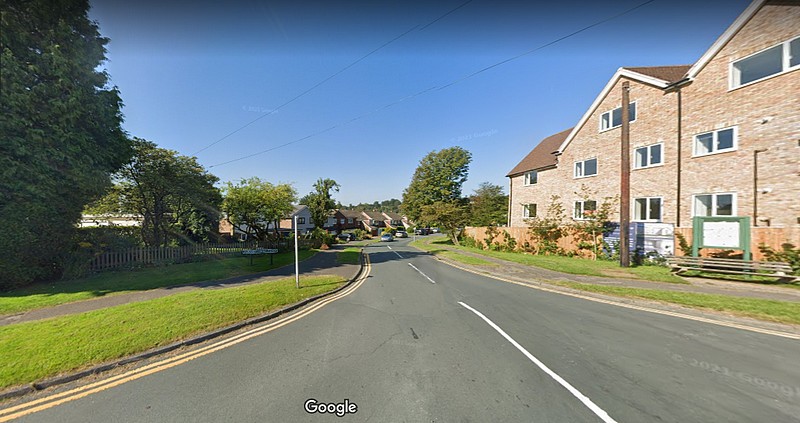
Google Streetview image looking from Whitehill Road into Harecombe Road, entry to the Harecombe estate.

HARECOMBE ESTATE, WHITE HILL ROAD, CROWBOROUGH
In 1979 the title deeds to a plot of land in Crowborough turned up in family records. The covering documents explained that a Mr & Mrs Harman had deposited the deeds with the family solicitor in 1903 in exchange for a loan of £2,250 - i.e. a mortgage. There is no evidence that the Harmans ever repaid anything that was due, and by 1912 the family still therefore certainly owned the land (although Harman was by then a tenant on it). No records beyond 1912 have been found, but the fact that the family still held the deeds in 1979 would suggest that the Gilbert family presumably still owned the plot! By that time about 50 houses had been built on it. This was a mystery worth solving, so here is the story.
On 27 November 1903, the executors of the late David Gilbert jnr. 1861-1902 (being his widow Ellen Isabel Gilbert, James Morris, ironfounder - her brother, and Oliver Mitchell, family friend and architect), apparently on the recommendation of family solicitor Isaac Vinall of Lewes, granted a mortgage of £2250 to Mr William Harman, builder of White Hill, Crowborough and his wife Mrs Marianna Lucy Harman, who provided the security of 3 1/2 acres of land to the north-west of Whitehill Road, Crowborough (then known as White Hill). This land incorporated what is now Harecombe Road, Harecombe Rise and parts of Southridge Road and Combe End. Title deeds of the property, together with the mortgage deed, were deposited with the solicitor and the agreed terms were 5% interest per annum (£112) for up to 40 years, and "also so long after that time [6 months] as any principal money remains due to pay interest thereon at the same rate by equal half yearly payments."
David Gilbert's widow, Ellen, had inherited considerable funds and property from her late husband and needed places to invest it. But a balance of the assets of the David's estate on 31 December 1908 showed an outstanding debt of £2,250 to Harman, which indicates that they had not repaid any of the money five years after taking out the mortgage.
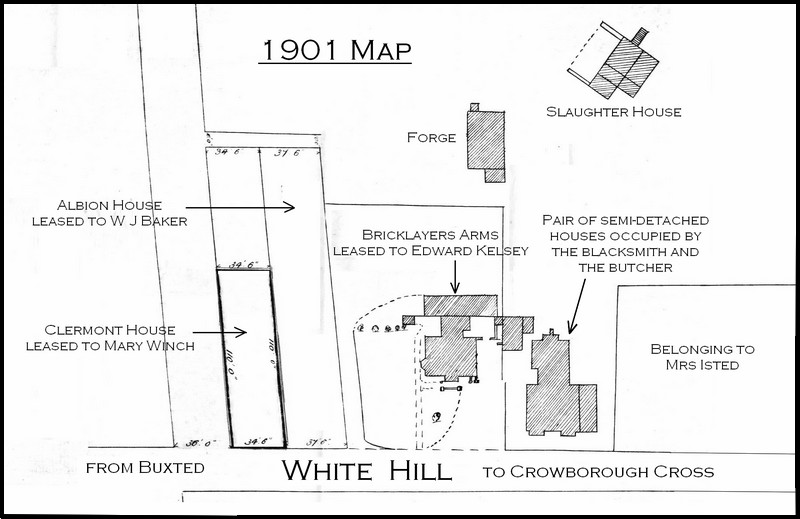
A map of 1901 which should help to identify the various features mentioned in the deeds shown below.
In 1889 Marianna Harman owned everything on this map except the plot marked "Belonging to Mrs Isted".
By 1903 the area between the Bricklayers Arms and the Forge had become a large stone quarry.
The parcel of deed documents as discovered in 1993 consisted of the following;
(Note; on 16 May 1868 the entire plot was purchased from the Earl of Abergavenny and the Earl of Chichester by Edward Latter, shopkeeper of
Rotherfield for £135.12.6. The estimated area was 4 acres, 2 roods [a rood was a quarter of an acre].)
1869; Conveyance from Edward Latter to Frederick John Novis, farmer, of part of the plot for £135. Map apparently relevant to this sale
and a summary (abstract) of Mr.Latter's title.
1871; Conveyance from Edward Latter to Frederick Novis of the rest of the plot for £150 and a summary of Mr.Latter's title.
1871; Mortgage for £200 from Frederick Novis to Montague Blaker, solicitor of Lewes.
1886; Two Inland Revenue accounts to Frederick Novis (he died in 1886 without repaying his debt, leaving a widow Anna, one daughter Clara,
one step-daughter Marianna, and no will).
1889; Marianna Harman (Frederick Novis's step daughter) suing various parties owing money to the late Frederick Novis.
1889; Reconveyance from Montague Blaker, solicitor, to Mrs Marianna Harman on payment of oustanding £400.
1896; Conveyance from Mrs Marianna Harman to her husband William Harman on payment of £400 (they became joint owners thereafter).
1896; Lease of the Bricklayers Arms from Mr & Mrs Harman to Edward Kelsey of Tunbridge Wells for 14 years at £35 per year.
1896; Mortgage from Mr & Mrs Harman to John Rose, farmer of Lamberhurst for £1,100 and, in 1898, a further mortgage for £200 from
Harman to Rose.
1899; Survey and valuation.
1899; Reconveyance from John Rose of Lamberhurst to Mr & Mrs Harman, their debt having been fully discharged.
1900; Lease of Albion House from Mr & Mrs Harman to William Torode Baker, grocer and general storekeeper, for seven years at £60 per
year, rising to £70.
1900-03; Two fire insurance policies.
1901; Lease of Clermont House from Mr & Mrs Harman to Mrs Mary Jane Winch, widow, for seven years at £65 per year.
1903-04; Fire insurance policy.
1903; Reconveyance from John Rose to Mr & Mrs Harman, a survey and valuation and an abstract of Mr & Mrs Harman's title.
1903; Mortgage from William Harman to the executors of David Gilbert, and a schedule of the deeds.
1906; Letters regarding a 2nd mortgage by Harman, and again in 1907.
1908; Letter regarding a fire insurance policy, but no policy, and the same again in 1909.
1910; Tenancy agreement from the executors of David Gilbert to Harman.
1910; Tenancy agreement from Gilbert to Ginger.
1911-12; Fire insurance policy taken out by the Gilbert executors.
Joanne Gilbert visited the East Sussex Record Office on 19 May 1995 and found many references in local directories. Some referred to (and were
the same as) the contents of the parcel of deeds as listed above, but the following were new;
1899; Harman, builder (occupier).
1915; Harman, builder / stonemason / quarry owner (occupier).
1918 and 1927; Harman (occupier).
1938; Cecil Harman (son of William?), builder, 2 Stone House, Whitehill Road.
It was a complex story, and Richard Gilbert senior wrote in 1979 "Now we come to the final mortgage deed, dated 27 November 1903, one day after it had been surrendered by Rose. Looking back over the history of the plot since Novis first acquired it in 1871, the record shows that the title deeds had only been in the owners' hands for 34 days in 42 years. Now, on Marianna's 48th birthday, it seemed as though she and her husband could not hand them over quickly enough."
Negotiations between the Harmans and solicitor Isaac Vinall had been taking place for some time. Henry Burt, a valuer from Burgess Hill, wrote to Vinall on 4 November describing the property as "consisting of about 3 1/2 acres of land with a stone quarry, 2 large dwelling houses and shops, blacksmith's forge, slaughter house and stable, and Mr Harman's own dwelling with cottage adjoining." He valued it all at £3,475 and thought that a loan of £2,250 could safely be advanced. This was the amount lent to the Harmans but, as events showed, not 'safely'! The agreement made with the Gilberts excluded the Bricklayers Arms, but included everything else.
There is a passage in the mortgage deed requiring the Harmans "to level and make the roads or intended roads shown on the said plan." This plan shows a road, parallel to White Hill, crossing the plot, dividing it roughly in half and passing over the forge. The deed permits the Harmans to remove the forge and erect other buildings of equal value. Another road is shown at right angles to White Hill, roughly along the line of an existing track which seems to have served the quarry, the forge and the slaughter house. Note that the Harmans never built either of those roads.
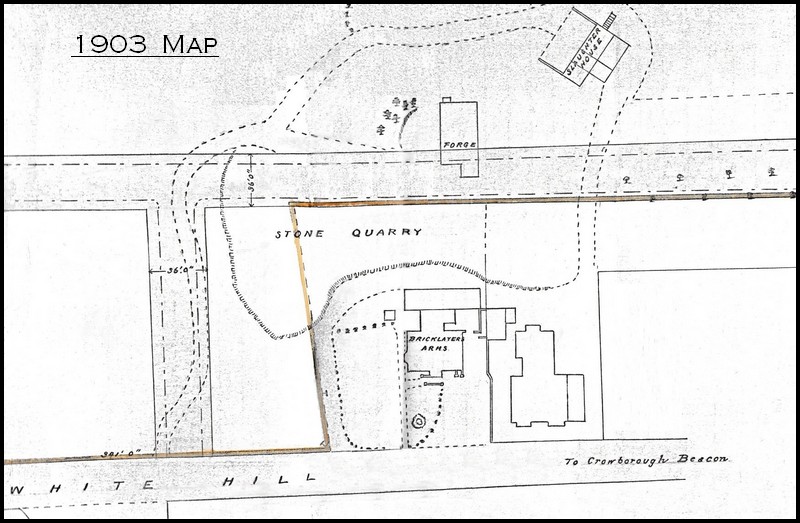
The map accompanying the 1903 deeds showing the proposed T-shaped roads (never built) and the former tracks which they would have replaced. It also shows the stone quarry. Clermont House and Albion House (which, by this time, incorporated shops) are surprisingly not shown, lower left of centre, but they did still exist, and the Harmans lived in one of them.
The tenancy agreement from Gilbert to Harman in 1910 confirms that William Harman was not the owner of the land at the time, but a tenant. Also it was a condition of the mortgage agreement that Harman paid the fire insurance on properties on the land, so the fact that the Gilbert estate was still paying for the insurance in 1911-1912 again suggests that the property was owned by Gilbert, not Harman at the time. However the occupant and freeholder of 19 Harecombe Rise, which they had bought from Gable Construction in 1964, wrote to H R Gilbert in 1997 to say that they had a copy of a conveyance from C N Harman to E S S Spyers in 1920. This presumably referred to Cecil Harman, possibly the son of William and Marianna Harman.
By 1911 Albion House was being used as a Post Office and, at some point, Clermont House became the Conservative Club (or possibly the other way round). Mr A V Divall confirmed to Richard Gilbert senior in 1979 that he had been sub-postmaster at White Hill Post Office (possibly the former Albion House) for many years, and he bought the quarry from Harman in 1925. A narrow strip of land at right angles to White Hill Road, and corresponding approximately to the unbuilt road shown on the 1903 map, belonged to a Mr Nicholson from the 1930s and 1959. Nicholson was still alive in 1979 and known to Mr Divall. The slaughter house was demolished in 1950 but the Bricklayers Arms still stands (the earliest record I've found of the pub is in Kelly's Directory of 1882 showing George Anscombe as landlord).
When Ellen Gilbert (David's widow) died in 1951, the property was not left in her will so presumably it had been disposed of in the interim. In 1959 a firm of builders, Grove Lodge Contractors Ltd of London SW9 (in association with St John Smith, estate agents of Uckfield), held a public auction for the purpose of assembling all the land that side of Whitehill Road for development, after which completely new deeds were raised. Having acquired all the land, it passed through several hands, winding up with Gable Construction Company of London SW18. Wealden District Council confirmed that Gable Construction received planning consent to develop the site as part of the Harecombe Rise and Harecombe Road area and about 120 houses were built on the entire estate, or which around 50 were built on the plot in question. The last road on the estate (Combe End) was handed over to the Highways Department in February 1962.
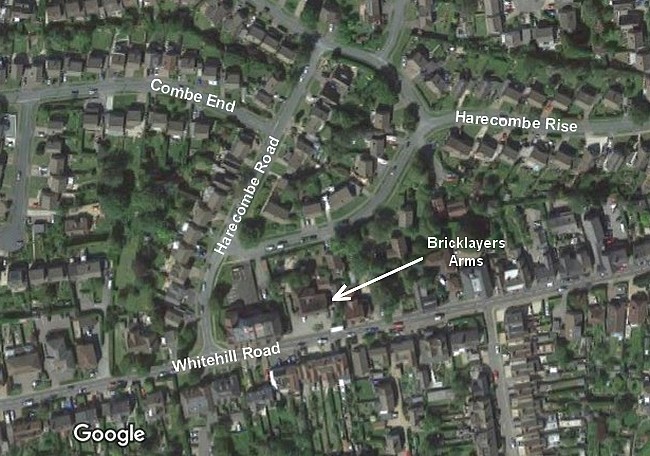
A Google map of the area in 2022.
It's hard to imagine how around 50 houses could have been built on the plot in the 1960s unless the developer could prove that they owned the land. So perhaps the matter was resolved some time between 1910 and 1950, and the Gilbert family only retained the deeds as a novelty and keepsake. Or maybe the matter was the victim of inaction, and time ran out. The Limitation Act 1980 says that "No action shall be brought by any person to recover any land after the expiration of twelve years" but I don't know what the rules were before 1980. One thing is certain, it's too late to do anything about it now!
All the deeds were donated to the East Sussex Record Office in May 2003, but many relevant documents are still held in H.R.Gilbert's records.